
RAR INSTITUTE STUDENT LEARNING EXPERIENCE AND INSTITUTIONAL FEEDBACK SURVEY REPORT 2026
RAR-INSTITUTE STUDENT LEARNING EXPERIENCE AND INSTITUTIONAL FEEDBACK SURVEY REPORT 2026
Reporting period: October 2026
Programmes: Diploma in Academic Research Studies
and Associate Degree in Political Science
| 120 | 80 | 66.7% |
| Officially enrolled students | Reported survey participants | Reported participation rate |
Prepared by
Rohingya Academic Research Institute (RAR-Institute)
Survey at a Glance
The report brings together official enrolment information and the student feedback themes documented for the October 2026 survey.
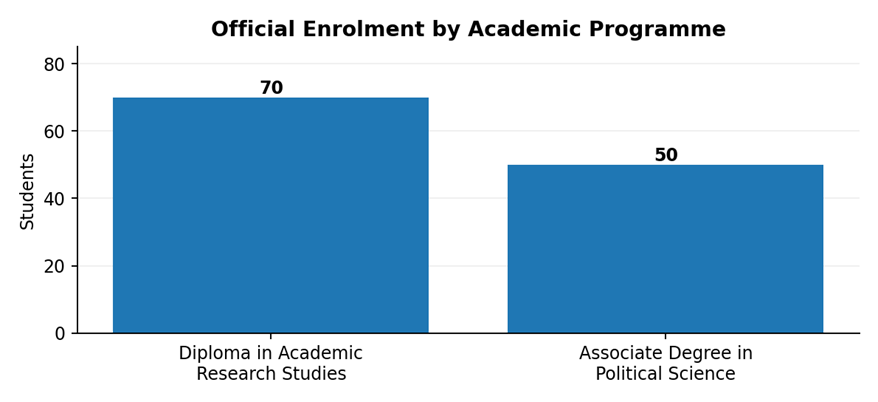
| Academic programme | Official enrolment | Share |
| Diploma in Academic Research Studies | 70 | 58.3% |
| Associate Degree in Political Science | 50 | 41.7% |
| Total | 120 | 100% |
Official enrolment by programme
Survey participation
Interpretation note: no verified semester-by-semester counts or numerical satisfaction scores were supplied; findings are presented as qualitative feedback themes.
1. Executive Summary
The Rohingya Academic Research Institute (RAR Institute) prepared this Student Learning Experience and Institutional Feedback Survey Report for October 2026 to review students’ learning experiences, recognise strengths, identify areas for improvement, and inform future academic planning.
The report covers two academic programmes: the Diploma in Academic Research Studies and the Associate Degree in Political Science. RAR Institute reports 120 officially enrolled students: 70 in the Diploma programme and 50 in the Associate Degree programme. The Institute reports that 80 students participated in the survey, representing 66.7% of total enrolment.
Feedback themes documented for this report indicate that students value clear explanations, supportive instructors, engaging classes, and access to academic opportunities. Students also recommended more practical learning activities, clearer assignment instructions, timely and constructive feedback, additional learning resources, flexible arrangements when connectivity or competing responsibilities affect study, and more regular academic communication.
2. Institutional Background
Founded in 2022, RAR Institute is a refugee-led nonprofit academic institution working to expand access to education, research training, academic development, and international collaboration. Its programmes seek to strengthen students’ subject knowledge, analytical abilities, research skills, academic writing, and capacity to contribute positively to their communities.
The Institute recognises that a positive learning experience depends on more than lesson delivery. Accessible learning materials, clear assessment expectations, constructive feedback, supportive instructors, effective communication, and opportunities to apply knowledge all contribute to academic development.
3. Objectives of the Survey
The survey was designed to assess students’ experiences and satisfaction with their academic programmes; understand their views on teaching quality and instructor support; review experiences with course materials, assignments, assessment, and academic progress; identify barriers that may affect participation and learning; collect recommendations for improving academic guidance, communication, and student support; and support programme review, institutional planning, and ongoing quality assurance.
4. Student Enrolment and Survey Participation
Official enrolment comprises 70 students in the Diploma in Academic Research Studies (58.3%) and 50 students in the Associate Degree in Political Science (41.7%), for a total of 120 students.
The reported survey participation is 80 students out of 120 officially enrolled students, equivalent to 66.7%. The findings are intended to guide institutional reflection and improvement, while recognising that individual experiences may differ across programmes, semesters, and personal circumstances.
5. Programme and Semester Considerations
Students’ academic needs may change as they progress through a programme. Students in early semesters may benefit from orientation, study skills, and clear explanations of academic expectations. Students in later semesters may require more advanced research activities, assignment guidance, revision opportunities, and individual support for complex coursework.
For future quality-assurance cycles, RAR Institute should continue to organise feedback by programme and semester. A verified semester-by-semester distribution for all 80 participants was not included in the information used to prepare this report.
6. Main Findings and Student Feedback Themes
Teaching and instructor support: Students appreciate clear explanations, approachable instructors, and an engaging learning environment. The Institute should continue encouraging instructors to explain difficult topics clearly, invite participation, and provide opportunities for clarification.
Practical and applied learning: Students recommended more case studies, group discussions, presentations, practical assignments, and real-world examples. These approaches can connect theoretical knowledge with practical situations.
Assignment instructions and assessment feedback: Students highlighted the importance of clear assignment expectations and constructive feedback. Assignment briefs should explain the task, expected structure, assessment criteria, submission requirements, and deadlines. Feedback should identify strengths, areas for improvement, and practical next steps.
Learning resources and connectivity: Access to learning materials and reliable internet connectivity can affect participation. Where feasible, the Institute could provide downloadable materials, written lesson summaries, advance access to readings, and offline-friendly resources.
Scheduling, communication, and academic guidance: Communicating schedules and deadlines early can help students plan their learning. Reasonable flexibility, where appropriate and consistent with academic requirements, may support students facing genuine access challenges. Regular announcements and clear channels for raising concerns can strengthen communication.
Broader skills development: Suggestions include research writing, English, digital literacy, communication, leadership, and career preparation. Targeted workshops could complement the core programmes and support further education, research activity, and professional responsibilities.
Student feedback themes at a glance
| TEACHING Clear explanations and supportive instructors | PRACTICAL LEARNING Case studies, group work, presentations | ASSESSMENT Clear briefs and constructive feedback |
| RESOURCES Downloadable and offline-friendly materials | COMMUNICATION Early schedules and regular updates | SKILLS Research, English, digital and leadership skills |
7. Recommendations and Action Plan
Assessment feedback — Encourage timely, constructive comments that explain strengths and next steps. Suggested timing: short term and ongoing.
Assignment guidance — Provide clear briefs, assessment criteria, deadlines, and examples where appropriate. Suggested timing: before each assignment.
Practical learning — Include case studies, presentations, group exercises, and applied activities in relevant courses. Suggested timing: each semester.
Learning resources — Review access to readings and provide downloadable resources or lesson summaries where feasible. Suggested timing: ongoing.
Communication — Share schedules, deadlines, and academic updates through consistent channels. Suggested timing: ongoing.
Academic mentoring — Provide opportunities for students to seek individual guidance on coursework and progress. Suggested timing: each semester.
Skills workshops — Offer relevant workshops in research, writing, English, digital literacy, communication, and leadership as capacity allows. Suggested timing: periodic.
Programme and semester review — Review feedback by programme and semester to identify different needs and priorities. Suggested timing: each survey cycle.
Follow-up survey — Repeat the survey periodically and communicate key actions taken in response. Suggested timing: periodic.
Action plan overview
| Priority area | Suggested timing |
| Assessment feedback | Short term and ongoing |
| Assignment guidance | Before each assignment |
| Practical learning | Each semester |
| Learning resources | Ongoing |
| Communication | Ongoing |
| Academic mentoring | Each semester |
| Skills workshops | Periodic |
| Programme and semester review | Each survey cycle |
| Follow-up survey | Periodic |
8. Limitations and Interpretation
The survey findings provide insights into students’ learning experiences, academic needs, and recommendations for improving the quality of education at RAR Institute. The report reflects the Institute’s official enrolment of 120 students across its two academic programmes and the participation of 80 students in the survey.
The findings highlight student perspectives on teaching quality, academic support, learning resources, assessment practices, communication, and opportunities for practical learning. Individual experiences and opinions may vary according to programme, semester, and personal circumstances. The findings should therefore be considered as guidance for institutional reflection and continuous improvement.
RAR Institute will continue to value student feedback as an important part of its commitment to academic quality, accountability, and the development of accessible educational opportunities for Rohingya students.
9. Conclusion
The Student Learning Experience and Institutional Feedback Survey Report 2026 provides RAR Institute with a structured basis for reflecting on its academic programmes and strengthening student support. With 120 officially enrolled students—70 in the Diploma in Academic Research Studies and 50 in the Associate Degree in Political Science—and 80 reported survey participants, the Institute has an opportunity to continue integrating student perspectives into its planning and quality-assurance processes.
The feedback themes point to practical priorities: maintaining clear and supportive teaching, expanding applied learning, improving assignment guidance and feedback, making learning materials more accessible, strengthening communication, and providing relevant mentoring and skills workshops. By reviewing these priorities regularly and implementing improvements within available capacity, RAR Institute can continue building an inclusive learning environment that supports academic growth and meaningful educational opportunities for Rohingya students.
Acknowledgement
RAR Institute extends its sincere appreciation to all students who participated in the Student Learning Experience and Institutional Feedback Survey and shared their perspectives and recommendations. The Institute also acknowledges the commitment of its instructors, academic staff, and volunteers who contribute to the delivery and development of its educational programmes. Through continued cooperation, respectful dialogue, and a shared commitment to academic quality, RAR Institute aims to expand meaningful educational opportunities for Rohingya students and future generations.
Discover more from Rohingya Academic Research Institute
Subscribe to get the latest posts sent to your email.
